
Strategies for Maximizing Social Security Benefits: What Every Woman Should Know Before Claiming
Planning for retirement is about more than saving money. It's about making informed decisions that support the lifestyle you've worked hard to build. One of the most important decisions you'll make is when and how to claim your Social Security benefits.
For many women approaching retirement, especially those who have experienced life changes such as divorce, widowhood, or a career break to care for family, Social Security can play an important role in an overall retirement income strategy. While benefits provide a valuable source of income, the choices you make about when to claim and how Social Security fits into your broader financial plan can have a lasting impact on your retirement.
The rules surrounding Social Security can seem complicated, but understanding the basics can help you feel more confident about your options. Whether retirement is just around the corner or still a few years away, taking time to evaluate your benefits today can help you make decisions that align with your long-term financial goals.
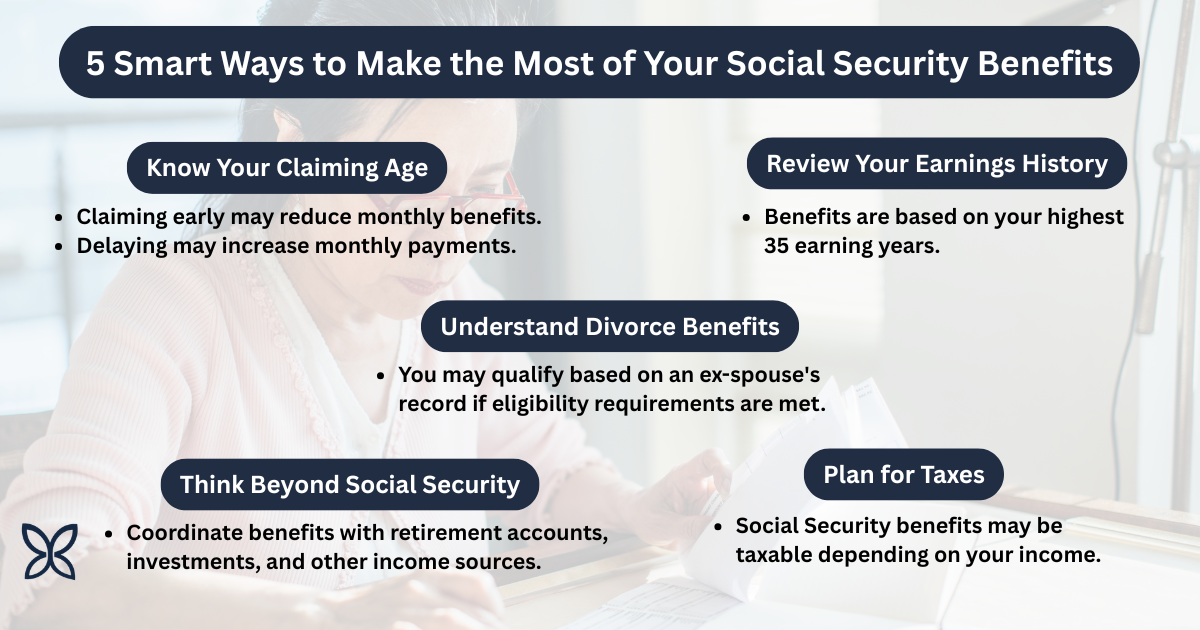
Social Security retirement benefits are generally based on your 35 highest earning years. If you've worked fewer than 35 years, years with no earnings are factored into the calculation, which may lower your benefit amount.
To qualify for retirement benefits, you'll typically need 40 work credits, which most people earn after approximately 10 years of work.
One simple but often overlooked step is reviewing your Social Security earnings record. Errors can occur, and correcting them before retirement may help ensure your benefit reflects your actual work history.
Because every career path is different, your benefit amount may vary significantly from someone else's, even if you're the same age.
While you can generally begin receiving retirement benefits at age 62, claiming before your Full Retirement Age (FRA) permanently reduces your monthly benefit. On the other hand, delaying benefits beyond your FRA can increase your monthly benefit amount through delayed retirement credits until age 70.
The right choice depends on your individual circumstances rather than simply selecting the earliest or latest option.
When evaluating when to begin benefits, consider questions such as:
Rather than focusing only on maximizing your monthly benefit, consider how your claiming strategy works alongside your savings, investments, pensions, and other income sources.
If you were married for at least 10 years, are currently unmarried, and meet certain eligibility requirements, you may be able to receive benefits based on your former spouse's work record.
In many situations:
Depending on your circumstances, you may qualify for up to 50% of your former spouse's retirement benefit.
If your former spouse has passed away, survivor benefits may also be available under certain conditions. Survivor benefits follow different eligibility rules, making it worthwhile to review all available options before filing.
Understanding these opportunities may help you make more informed retirement planning decisions.
Because benefits are based on your highest 35 years of earnings, replacing lower-income years with higher earning years could increase your benefit calculation.
Continuing to work may also allow you to delay claiming benefits, which can increase your monthly benefit amount if delaying aligns with your retirement goals.
However, financial considerations are only one part of the decision.
You may also want to think about:
Retirement planning is ultimately about creating a balance between financial preparedness and the life you want to enjoy.
Your combined income, which includes wages, retirement account withdrawals, investment income, and a portion of your Social Security benefits, helps determine whether part of your benefit may be subject to federal income tax.
While taxes cannot always be avoided, thoughtful planning may help improve the overall efficiency of your retirement income.
Strategies that may be worth discussing include:
Every retirement situation is different, so these strategies should be considered within the context of your broader financial picture.
For many women approaching retirement, especially those who have experienced life changes such as divorce, widowhood, or a career break to care for family, Social Security can play an important role in an overall retirement income strategy. While benefits provide a valuable source of income, the choices you make about when to claim and how Social Security fits into your broader financial plan can have a lasting impact on your retirement.
The rules surrounding Social Security can seem complicated, but understanding the basics can help you feel more confident about your options. Whether retirement is just around the corner or still a few years away, taking time to evaluate your benefits today can help you make decisions that align with your long-term financial goals.
Understanding How Social Security Benefits Are Calculated
Before deciding when to claim benefits, it's important to understand how your monthly payment is determined.Social Security retirement benefits are generally based on your 35 highest earning years. If you've worked fewer than 35 years, years with no earnings are factored into the calculation, which may lower your benefit amount.
To qualify for retirement benefits, you'll typically need 40 work credits, which most people earn after approximately 10 years of work.
One simple but often overlooked step is reviewing your Social Security earnings record. Errors can occur, and correcting them before retirement may help ensure your benefit reflects your actual work history.
Because every career path is different, your benefit amount may vary significantly from someone else's, even if you're the same age.
When Is the Best Time to Claim Social Security?
One of the most frequently asked retirement questions is whether it's better to claim Social Security as early as possible or wait.While you can generally begin receiving retirement benefits at age 62, claiming before your Full Retirement Age (FRA) permanently reduces your monthly benefit. On the other hand, delaying benefits beyond your FRA can increase your monthly benefit amount through delayed retirement credits until age 70.
The right choice depends on your individual circumstances rather than simply selecting the earliest or latest option.
When evaluating when to begin benefits, consider questions such as:
- What other retirement income sources will you have?
- Will you continue working during retirement?
- How much income will you need each month?
- What are your anticipated healthcare expenses?
- How does Social Security fit within your overall retirement strategy?
- What retirement lifestyle do you hope to maintain?
Rather than focusing only on maximizing your monthly benefit, consider how your claiming strategy works alongside your savings, investments, pensions, and other income sources.
Important Social Security Considerations After Divorce
Many women are surprised to learn that divorce may create additional Social Security options.If you were married for at least 10 years, are currently unmarried, and meet certain eligibility requirements, you may be able to receive benefits based on your former spouse's work record.
In many situations:
- Your former spouse does not need to approve your claim.
- Your former spouse may be remarried.
- Receiving divorced spouse benefits generally does not reduce your former spouse's benefit.
Depending on your circumstances, you may qualify for up to 50% of your former spouse's retirement benefit.
If your former spouse has passed away, survivor benefits may also be available under certain conditions. Survivor benefits follow different eligibility rules, making it worthwhile to review all available options before filing.
Understanding these opportunities may help you make more informed retirement planning decisions.
Can Working Longer Increase Your Benefit?
Retirement doesn't always happen on a fixed timeline. Some individuals choose to continue working part time or full time, and that decision may influence future Social Security benefits.Because benefits are based on your highest 35 years of earnings, replacing lower-income years with higher earning years could increase your benefit calculation.
Continuing to work may also allow you to delay claiming benefits, which can increase your monthly benefit amount if delaying aligns with your retirement goals.
However, financial considerations are only one part of the decision.
You may also want to think about:
- Your health and well-being
- Career satisfaction
- Family responsibilities
- Desired retirement lifestyle
- Other retirement income sources
Retirement planning is ultimately about creating a balance between financial preparedness and the life you want to enjoy.
Understanding Taxes on Social Security Benefits
Another important consideration is that Social Security benefits may be taxable depending on your income.Your combined income, which includes wages, retirement account withdrawals, investment income, and a portion of your Social Security benefits, helps determine whether part of your benefit may be subject to federal income tax.
While taxes cannot always be avoided, thoughtful planning may help improve the overall efficiency of your retirement income.
Strategies that may be worth discussing include:
- Coordinating withdrawals from retirement accounts
- Evaluating Roth IRA conversion opportunities
- Managing taxable investment income
- Diversifying retirement income sources
- Planning distributions over multiple years
Every retirement situation is different, so these strategies should be considered within the context of your broader financial picture.
Make Social Security Part of Your Overall Retirement Plan
Social Security is only one piece of retirement planning. Your retirement income may also include employer retirement plans, IRAs, investment accounts, pensions, savings, and other assets. Looking at these resources together rather than individually often provides a clearer understanding of how they may support your retirement lifestyle.A comprehensive retirement plan may include:
- Retirement income planning
- Investment management
- Tax planning considerations
- Healthcare expense planning
- Inflation considerations
- Estate planning
- Legacy planning for future generations
By viewing Social Security as one component of a larger financial strategy, you can better understand how different decisions may affect your retirement over time.
Estate Planning Matters Too
Retirement planning doesn't stop once benefits begin. Many individuals also want to preserve assets for children, grandchildren, charities, or other loved ones.An estate plan helps organize how your assets will be distributed while also documenting your wishes for future financial and healthcare decisions.
Regularly reviewing your estate planning documents, beneficiary designations, and retirement accounts can help ensure they continue reflecting your goals as life changes.
Even small updates over time may help keep your financial plan aligned with your priorities.
Common Social Security Mistakes to Avoid
Social Security decisions are often permanent, making it worthwhile to avoid common misconceptions.Some of the most frequent mistakes include:
- Claiming benefits without considering long-term retirement income needs.
- Assuming everyone should claim at age 62.
- Forgetting to review your Social Security earnings history.
- Overlooking divorced spouse or survivor benefit eligibility.
- Making decisions based solely on friends' or family members' experiences.
Every retirement plan is unique, and what works well for one individual may not be appropriate for another.
Taking time to evaluate your personal financial circumstances can help you approach these decisions with greater confidence.
Work With a Devoted Financial Professional
Navigating Social Security is rarely about finding one "perfect" answer. Instead, it's about understanding how your benefits fit into your broader retirement goals.A devoted financial professional can help you evaluate how Social Security interacts with your retirement savings, investment accounts, taxes, healthcare expenses, and long-term financial objectives.
By taking a comprehensive approach, you can better understand your options and make informed decisions that support the retirement lifestyle you've envisioned.
Start Planning Today
Social Security is an important part of retirement planning, but it works best when it's considered alongside every other aspect of your financial life.Whether retirement is approaching quickly or you're still several years away, taking time now to understand your options can help you feel more prepared for the future.
At Wyse Financial Group, we believe every retirement plan should reflect your unique goals, values, and financial circumstances. Our devoted advisors take the time to understand the complete picture and help you evaluate strategies that align with your long-term objectives.
Ready to discuss your retirement strategy? Contact Wyse Financial Group today to schedule a conversation about your retirement income plan and how Social Security may fit into your overall financial strategy.